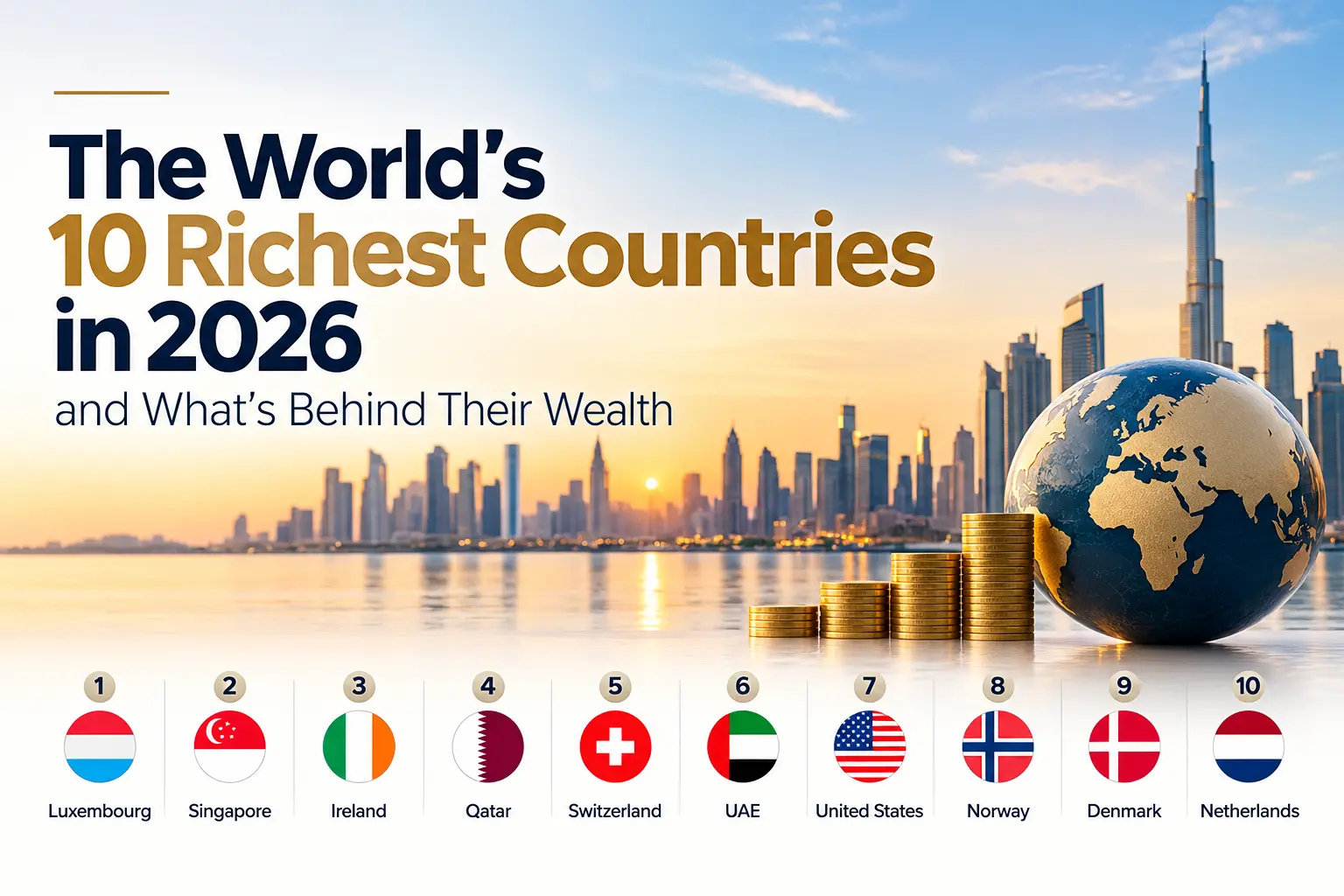
The World's 10 Richest Countries in 2026, and What's Behind Their Wealth
Ask someone what makes a country rich and they'll probably say "lots of money." But it's a bit more interesting than that. A nation's wealth comes from how productive its people are, how stable its institutions feel, what resources it sits on, and how well daily life actually works for the folks living there.
Here's something you'll notice quickly: a lot of the richest countries are tiny. They don't have huge populations or sprawling land. What they have is a knack for doing one or two things exceptionally well, whether that's finance, energy, technology or trade. And that success tends to spill over into their cities, their lifestyles and, of course, their property markets.
So let's walk through ten of them.
First, How Do You Even Measure a Country's Wealth?
The number most people lean on is GDP per capital. Take everything a country produces in a year, divide it by the number of people, and you get a rough sense of economic output per person.
It's a handy shortcut, but it doesn't tell you everything. A country can look rich on paper while living costs are sky-high, or while wealth is concentrated in very few hands. Purchasing power, savings and how fairly income is spread all change how "rich" a place feels in real life.
1. Luxembourg
You'd barely spot it on a world map, yet Luxembourg tends to sit right at the top of GDP per capita rankings. The secret is finance. Investment funds, international banks and a highly skilled workforce have turned this little country into one of Europe's most important financial centres.
Throw in political stability, great infrastructure and a very comfortable standard of living, and the picture makes sense.
2. Singapore
If you want proof that size doesn't limit ambition, look at Singapore. Smart planning, an efficient government, a brilliant location and strong trade relationships have made it a favourite base for global companies and investors.
Its real estate reflects that success too, with sleek residential towers, buzzing business districts and some of the priciest property in Asia.
3. Ireland
Ireland has quietly become Europe's headquarters for tech and pharmaceutical giants. Many of the world's best-known companies run their European operations from here, which means jobs, investment and a lot of economic energy.
Dublin sits at the centre of it all. As the city has grown into a serious business hub, demand for good housing and commercial space has followed.
4. Qatar
Qatar's wealth starts with natural gas, and there's a lot of it. What stands out is what the country has done with the money. Instead of just sitting on it, Qatar has invested heavily in infrastructure, transport, education, tourism and city building.
Doha today is a modern, polished city with luxury hotels, upscale residences and big commercial developments.
5. Switzerland
Think banking, pharmaceuticals and precision manufacturing, and you're thinking of Switzerland. Zurich and Geneva are global names in finance and business.
Part of the appeal is its reputation for stability and quality. High-net-worth individuals and international companies like knowing exactly what they're getting.
6. United Arab Emirates
The UAE has changed enormously in just a few decades. Oil and gas still matter, but the country has branched out into real estate, tourism, aviation, logistics, finance and technology.
Dubai and Abu Dhabi are especially known for luxury property. With a skyline that gets photographed constantly, branded residences and investor-friendly policies, Dubai has become a magnet for buyers from all over the world.
7. United States
The US has the biggest economy on the planet by nominal GDP. Some of the world's largest technology, finance, healthcare, entertainment and manufacturing companies call it home.
Cities like New York, Los Angeles, Miami and San Francisco have property markets that command serious value. Its culture of innovation and enormous consumer base keep attracting businesses and investors from everywhere.
8. Norway
Norway built its prosperity on oil and natural gas, but what really sets it apart is how it handled the proceeds. It created a huge sovereign wealth fund that invests energy income for the long-term benefit of the country.
Add excellent public services, solid infrastructure and a high quality of life, and you get one of Europe's strongest economies.
9. Denmark
Denmark's economy is wonderfully balanced. Pharmaceuticals, renewable energy, shipping, technology and manufacturing all play a part.
Copenhagen is often praised for its quality of life, modern infrastructure and thoughtful, sustainable city design. Denmark shows that a competitive business environment and strong social support can actually work together.
10. Netherlands
The Netherlands is one of Europe's key trade and logistics hubs, and Rotterdam, one of the continent's busiest ports, is a big reason why. Trade, technology, finance, agriculture and manufacturing all feed its economy.
Amsterdam is a leading business and financial centre, while other Dutch cities add real strength in tech and logistics.
Keep in mind that rankings shift depending on whether you use nominal GDP per capita, purchasing-power-adjusted figures or another measure of wealth.
What Do These Rich Countries Have in Common?
On the surface, they couldn't be more different. One runs on gas, another on banking, another on pharmaceuticals. But look closer and the same few ingredients keep showing up:
Strong infrastructure. Good roads, transport, digital connectivity and healthcare make life easier for people and business smoother for companies.
Stability. Investors, local and foreign, put their money where things feel predictable and safe.
Skilled people. Education and expertise drive productivity, innovation and higher-value industries.
Openness to investment. Trusted institutions and strong financial systems draw capital from around the globe.
Premium real estate. Where the economy thrives, demand for luxury homes, high-end apartments and commercial space naturally grows.
So, What Can India Take From This?
India is a completely different story from Luxembourg or Qatar, with its own size, population and economic makeup. Still, there are real lessons in how these countries got where they are. Putting money into infrastructure, technology, education and efficient transport, while keeping the doors open for business, tends to pay off over the long haul.
You can already see that kind of momentum in parts of India. Delhi NCR, Noida and Greater Noida are growing steadily across residential, commercial, infrastructure and technology sectors. That growth is opening up opportunities across the whole property spectrum, from affordable homes to premium and luxury apartments.
Why Economic Growth and Real Estate Go Hand in Hand
It's a simple chain, really. When businesses grow, they hire. When more people have jobs, they need homes. When companies expand, they need offices, shops and warehouses. Property demand rises along with all of it.
So if you're thinking about property in Noida, try to look past today's price. Think about the location, the developer's track record, the infrastructure around it, the rental potential and where the area is headed in the next ten years. A property that checks those boxes is far more likely to keep rewarding you long after you've bought it.